Tuesday, October 20, 2009

Chamber Strings - 1st Rehearsal

*Chamber Strings*

Congratulations on your successful audition! Here’s a little information about Chamber Strings that you should know:

Chamber Strings rehearses every Monday during Activity Period (3:30-4:05pm).

Be in your seat no later than 3:35pm! I will have an electronic tuner available. Come early so that you can learn how to use it yourself! If you need help tuning, allow enough time to get to the orchestra room, (ask me or a willing 8th grade student) to tune you, and still be in your seat by 3:30pm.

You must attend every rehearsal! If you need to miss a rehearsal, speak to me before you miss so that we can arrange for you to play for me.

This year, Chamber Strings is comprised of 6th, 7th, and 8th Grade students. Chamber Strings is an extracurricular activity, so it is important that you remain in good standing in regular orchestra.

This means you must still attend lessons regularly and continue to maintain a high level of mastery on your orchestra music.

Chamber Strings will perform on a variety of concert programs this year. All musicians are necessary for a successful concert, so mark your calendars with the following dates:

February 10, 2010 Select Concert @ FMS 7:30pm

February 25, 2010 Young People’s Concert @ GHS 12:15pm

June 9, 2010 Dessert Concert @ FMS 7:30pm

    We may also perform for the community in other small venues.

I look forward to having fun and making music with you this year!


The following students attended the first Chamber Strings rehearsal yesterday:

Gloria Zhao
Katie Gonick
Arianna Barnum
Bill Dong
William Wang
Erin Templeton
Marko Crnkovic
Catherine Rafferty
Andrea Long
Naila Brown
Cody Ingraham

Sports and doctor/teacher appointments kept Joe, Ali, Rachel, and Emma from being with us, but we hope to see them soon! We're sorry we missed Michelle, Katie and Sydney.

At rehearsal, we read up to measure 18 in Adirondack Sleighride, and will prepare up to measure 30 for next time. Most of our time was spent working on Winter from Vivaldi's 4 Seasons. This piece is slower than you might think, and it is well-suited for practice with a metronome. Don't spend time practicing Entrance to the Queen of Sheba. I have some other selections in store.

Tuesday, October 20, 2009

8th Grade

Great rehearsal of Frippery today! We are feeling more comfortable reading in cut time, and I'm glad to hear your right hand (bow) technique becoming more uniform as we learn to listen to each other.

We began rehearsal with Bb and D Major scales. When practicing scales, use the solfege pitches that you are already familiar with first. Once you can sing a major scales, remind yourself of the key signature (how many sharps or flats), and combine this knowledge with your listening skills to figure out the scale on your instrument.
Never let practicing scales be boring! Are your half steps close together? Have you used your open strings to help you tune? Can you play familiar patterns? Use all of the skills we are developing in orchestra at home!

Practice logs were distributed in orchestra today. If you were absent, see me right away for your copy of this assignment.
At this point in the year, we should be involved in a regular and routine practice schedule. The practice logs are a way that I can now track your progress, questions, and preparation for orchestra. Each day, record how long (in minutes) you practiced each of the assignments in the corresponding boxes. Have your parents initial your work when completed. Unlike other practice charts you may have received, these should be initialed every day for full credit. Also new: there is no "minimum" amount of practice. Schedules vary, and though successful students practice for 30 minutes or more per day, I understand that this is not always possible. You will not be penialized if your chart does not reflect 3.5 hours of practice (30min x 7 days) per week. I want to see a balanced chart, with focused practice of each assignment throughout the course of the week even if this means only doing one or two assignments each night.

Practice logs for 8th grade will be collected and assessed on Wednesday, October 28th. Bring your practice log to class that day -- late work will not be accepted.


The first round of seat tests will occur after these practice logs have been submitted. I will take your daily practicing record into account when grading your seat/performance tests. Completion of practice logs will only increase your grade.


6th Grade (B/D)

Thank you to all 6th graders who already had their violin and viola cases marked with their names, grades, phone numbers, and addresses! There were more identified 6th grade cases than any other grade. I added tags to cases that were not identified, and I ask that you put this important information on the tags immediately! Many people go in and out of the instrument storage room on a daily basis, and I want to know that all instruments are safe.

C Major scales are getting better. After a few tries, we even were feeling more comfortable echoing tonal patterns in this new key. Students are becoming more discriminating when it comes to pitch and octave, and I encourage you all to keep up this excellent focus!

The 6th grade was introduced to my worksheets today, and I'm sorry that the title was confusing. Although we are working through our own parts in Carmen, Carmela, it is important that we know what's going on around us. To make us more aware, I created performance-worksheets in which the entire orchestra can play specific sections of a piece in unison. Today's worksheet focused on the soli sections in the viola and cello parts. While violins and basses never actually see this material in their original parts, activites like this one provide valuable information about other sections, allow us to layer on new parts, and -- if nothing else -- gives us some relevant sight-reading. We will use this approach in orchestra often in the future.

The D.S. challenge was answered today by:
Sarah Hanlon (what it stands for)
Matthew Darby (what it means)
Rachel Cardiff (what you do when you see it)

As usual, written responses were collected. I'll have the team rankings posted in the next few classes! Please remember to put your name on your written response so that I can give your team credit!


(I'll define D.S. in the near future -- the other 6th graders have to have a chance to answer first)


7th Grade (Yesterday)

No Challenge question for next class (tomorrow). We caught up and answered 2 challenge questions yesterday:

1.
Q. A ground is a short melody which is performed over and over again by a bass instrument or voice. Above the theme, a string of continuous variations are unfolded. In the case of Variations on a Ground however, the ground melody moves from one instrument to another. What is the word for a variations on a short melody in which the melody moves from one instrument to another?

A. Passacaglia. Refer to the blog entry on October 13th for an excellent Passacaglia for either violin & viola or violin & cello by Handel-Halvorsen. For those of you who want to pronounce it: pass-ah-KAHL-ee-ya

Congratulations to Gianluca who knew the answer to this challenge!


2.
Q. Define: tutti.
A. An Italian word meaning all or together.
It may refer to an orchestral passage in which every member of the orchestra (or a section of an orchestra) is playing at once. For instance, in a concerto it indicates the parts for the whole orchestra as opposed to the soloist.

The challenge winners for tutti were: Jo Ann Mulligan, Carrie Rose Mulligan, Walter Nyangaga, Michelle Yu, Julia Sanford, Gianluca Russo, Maddy Farry, Jacob Rosenberg, Hannah Hernandez, Christina Morawski, Kristina Marinopoulos, Elijah Clemente, and Vivian Dai. Congratulations! Your answers helped your team :)

The current team ranking is:

First Place: The Unknowns
Second Place: String Rockers
Tie for Third Place: Firepeople, Gruesome Threesome, 9
Tie for Fourth Place: Four Musicians, Magnificant Music Makers, Team 11
Tie for Fifth Place: The Nobodies, Electric Purple Pandas, Strawberries

In orchestra yesterday, the 7th grade sharpened their skills in a more unfamiliar passage of Variations on a Ground, using a performance-worksheet similar to that described in the 6th grade entry. Violins should continue to focus on this section (measure 33 and beyond) until they feel comfortable playing it at a variety of tempos.

Next class, we will use the same handout, this time focusing on the excercises for Saturday at the Symphony.


Tuesday, October 13, 2009

Performance Opportunity

Is anyone interested in providing string accompaniment for the choir in their performance of John Lennon's Imagine? We'll have the music, and it will involve you going to some choir rehearsals to coordinate. Talk to me in class if this sounds like something you might want to do!

Tuesday, October 13, 2009


Congratulations to the first challenge winners!

In the 6th grade orchestras, the following students defined fermata correctly in at least one of three ways:

Michelle Yu, Carrie Rose Mulligan, Jo Ann Mulligan, Lucas Laing, Marko Crnkovic, Alana Lake, Matthew Darby, Sara Kogelmann, Bill Dong, Libbie Reedy, Matt Lurie, Gloria Zhao, Ahna Pearson, Michael Zhu, Britany Nauman, Bridget Bellanger, and Eva Mazzella, and Alex Beams


A fermata (I did not accept "hold," "pause," "bird's eye," or "corona" as these are colloquial) is an element of musical notation indicating that the note should be sustained for longer than its note value would indicate. Exactly how much longer it is held is up to the discretion of the performer or conductor, but twice as long is not unusual. Occasionally holds are also printed above rests or barlines, indicating a pause of indefinite duration.

The next 6th grade challenge is to define another symbol that is found in the same measure of Carmen, Carmela that the fermata is found in. Just like the last challenge, I will ask:

1. The official name of the symbol (hint:
"double pipes," "train tracks," or "railroad tracks" will not be accepted).
2. What the symbol actually means/why you would find it in the music.
3. What you, as the performer, should do when you come across this symbol.

I also have to commend the 6th grade for their excellent rehearsal today. We played the first movement of Miniature Symphony, and I was extremely impressed with the level of focus, cooperation, and enthusiasm that the students maintained in their exploration of new music.


The 7th grade challenge is a bit more difficult than their last challenge.* This is the challenge:


A ground is a short melody which is performed over and over again by a bass instrument or voice. Above the theme, a string of continuous variations are unfolded. In the case of Variations on a Ground however, the ground melody moves from one instrument to another.

What is the word for a variations on a short melody in which the melody moves from one instrument to another?

Hint: In 1894, a Norwegian violinist, composer, and condu
ctor (Johan Halvorsen) wrote a demanding work based on the 7th Harpsichord Suite by George Friedrich Handel in this type of variation form. The form he used is from the Baroque era and is said to derive from a Spanish dance. It unfolds as a continuous theme, usually in moderately slow triple meter (instead of double, like Variations on a Ground), with slow harmonic rhythm changing generally with the measure. Searching on youtube for "Handel-Halvorsen" will bring you to many great videos, both recent and vintage. Here's a newer recording. Here's an older one. Halvorsen's piece was written for violin & cello, but it has become more common to find the violin & viola version performed.


Good Luck!


*For those interested, the answer to the 7th grade challenge (Name the famous piece quoted in measure 42 of Saturday at the Symphony) was Symphony No. 1, movement IV, by Johannes Brahms. This famous excerpt is played by the string section of the orchestra. The answer to this challenge could be found in the post "7th Grade Fall Repertoire" on this blog.


Did any 8th grade violinists miss their lessons today? Here's what was assigned for next week from the Rhythmic Training packet:

Bb Major Scale - know the key signature and be able to play a 2-octave scale for me
Robert Starer: p20 review lines 1 & 2; p21 review line 1
Suzuki Position Etudes: 2nd position p11 lines 1, 2, 3; p12 line 1; Perpetual Motion (p 13) line 1
Sitt Studies: p2 (#41) lines 1 & 2

Wednesday, October 7, 2009

Wednesday, October 7, 2009

I'm glad to be back at Farnsworth today, and I am thankful for the good substitute reports I received.

This past weekend, I observed the orchestra rehearsals of some of my talented former teachers. I learned a lot by watching their students from the Hudson Valley region rehearse and practice together, and I will be implementing some ideas over the next few weeks. The newest change came for the 6th grade today, and the other half of the 6th grade will experience it tomorrow: a new seating arrangement!

The 6th grade is learning to work together as an ensemble. To play well together requires careful listening and attention, and in a European-style seating plan, each section has the opportunity to sit next to another instrument, hear a different range of pitches, and experience different parts of the music. This seating plan will also reduce the need for movement between violin sections (as firsts and seconds switch depending on the piece), and it will help instrumentalists develop independence of parts.

What exactly is European (German) seating? What were we doing before?

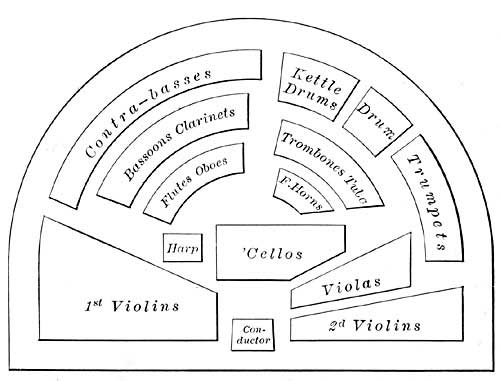
We, as string players, are often arranged in the standard American seating arrangement, with violins next to violins, violas between cellos and 2nd violins, and basses behind cellos. This is what this arrangement looks like. The American style is often referred to as "standard seating," and has evolved due to symphonic demands.

Some may refer to our new arrangement as the Furtwangler formation, but it is rare to find someone who requires distinction between the European/German and Furtwangler arrangement. Traditional European/German seating looks like this.
The Furtwangler formation differs in that the viola and cellos sections are switched, and the basses orient themselves at different points in the back of the ensemble.

For those who desire more information, remember that our goal is always to produce a good sound. This website has recordings made by both orchestras in both formations. Listen for yourself and decide which sounds you like!

Sunday, October 4, 2009

Chamber Strings

Chamber Strings seating is now posted outside of the orchestra room! Find your name and section and take a practice part from the folder labeled "Chamber Strings" -- right beneath the seating.


First rehearsal will be on Monday, October 19th during Activity Period. Look at Winter and Adirondack Sleighride as we will be reading those two pieces at our first rehearsal.


Violin 1

Stand 1

Joe Sipzner, Concertmaster

Gloria Zhao, Assistant

Stand 2

Ali Gohlke-Schermer

Katie Gonick

Stand 3

Arianna Barnum

Violin 2

Stand 1

Bill Dong, Principal

William Wang, Assistant

Stand 2

Erin Templeton

Marko Crnkovic

Stand 3

Rachel Swyer

Viola

Stand 1

Emma Pearson, Principal

Catherine Rafferty, Assistant

Stand 2

Michelle Burmistrova

Cello

Stand 1

Andrea Long, Principal

Katie Yang, Assistant

Stand 2

Naila Brown

Cody Ingraham

Stand 3

Sydney Marotta

Keeping Score

Starting October 15th, the second season of Keeping Score will air on PBS. Presented by the San Francisco Symphony under the direction of Michael Tilson Thomas, the series will present documentary-style concerts with the theme of composers who have struggled with musical language as a unique expression of their ideas.

Use this website's interactive page to explore different musical works, composers, and themes.